This paper examines the penalty provisions in the draft Romanian implementing law proposed by the Romanian government on 22 July 2025. It briefly considers the draft's legislative status, assesses its compliance with EU-MER, and compares it with good practice in Denmark and with Italy's draft law.
This paper examines the penalty provisions in the draft Czech implementing law submitted on 11 November 2025 by the Minister for the Environment to the Prime Minister. It briefly considers the draft's legislative status in light of the political situation following the 3–4 October general election, assesses its compliance with the EU-MER, and compares it with good practice in Denmark and with Italy's draft law.
After giving a concise overview of the penalty provisions in the EU Methane Regulation (EU-MER), this paper counters the scaremongering narrative promoted by fossil energy groups that the EU-MER creates "unmanageable liability" for EU fossil-fuel importers through fines of up to 20% of annual turnover.
A competitive, clean, and fair EU economy depends on smarter governance practices. This paper proposes eight priority actions for simpler, leaner, and more performance-oriented transition governance in the EU.
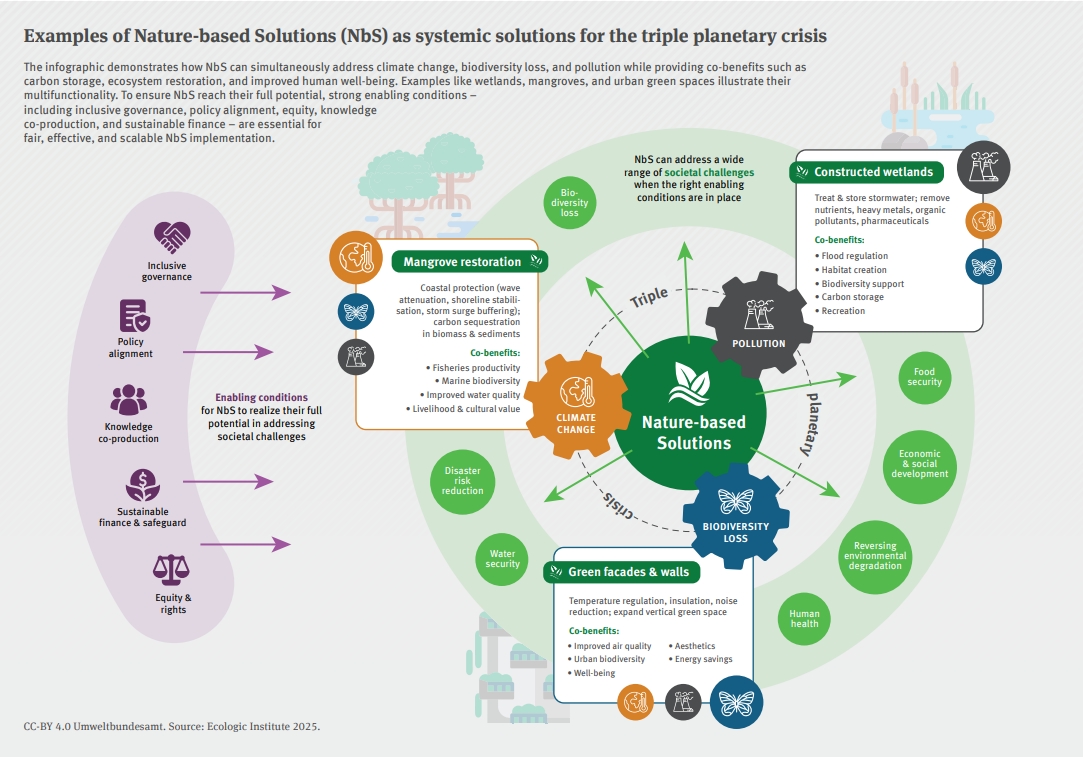
A series of four infographics visualises the key insights of two closely related reports on the triple planetary crisis published by the German Environment Agency (UBA): "The Interconnected Challenges of Climate Change, Biodiversity Loss and Environmental Pollution: Drivers, Interdependencies and Impacts of the Triple Planetary Crisis" and "Moving from Interconnected Crises to Systemic Solutions. Resource Efficiency, Nature-based Solutions, and Systemic Transformation as Responses to the Complexity of the Triple Planetary Crisis". Together, they translate complex analyses into accessible visual narratives.
The fact sheet explains why climate change, biodiversity loss and environmental pollution must be understood as a systemically interconnected crisis driven by shared pressures such as resource use, land-use change and structural inequalities. It highlights how direct and indirect drivers interact across sectors and regions, creating reinforcing feedbacks and compounding risks for ecosystems and societies.
Humanity has already exceeded six of the nine planetary boundaries, with climate change, biodiversity loss, and pollution pushing the Earth system beyond its safe operating space. Because these boundaries interact through complex feedback loops, surpassing one accelerates pressures on the others, creating cascading effects that amplify environmental degradation. This interconnected dynamic is driving a systemic triple planetary crisis, or polycrisis, that undermines ecological resilience and threatens long-term human well-being. Addressing it requires integrated, cross-sectoral approaches that tackle shared drivers and deliver co-benefits across environmental and socio-economic domains.
This fact sheet summarizes the information contained in the publication Burgos Cuevas et al. (2025): Moving from interconnected crises to systemic solutions. Resource efficiency, nature-based solutions, and systemic transformation as responses to the complexity of the triple planetary crisis. Interim report, Climate Change 83/2025. German Environment Agency: Dessau-Roßlau. https://doi.org/10.60810/openumwelt-8108.
The triple planetary crisis is a systemic challenge, not three separate issues: climate change, biodiversity loss, and pollution reinforce one another through shared drivers and feedback, threatening planetary and human well-being. It is driven by fossil fuel dependence, unsustainable production and consumption, overexploitation of land and resources, and structural inequalities. The analysis concludes that the triple crisis can only be effectively addressed through systemic, cross-sectoral, and justice-oriented approaches. By linking resource governance, NbS, and transformative change, this report highlights how today’s triple crisis can be turned into an opportunity to regenerate ecosystems, reduce inequalities, and build resilient societies within planetary boundaries.
This report, commissioned by the German Federal Agency (UBA), provides a systematic analysis of this triple planetary crisis. It demonstrates why climate change, biodiversity loss, and environmental pollution cannot be understood and tackled in siloes, but instead share common drivers, feedback mechanisms, and cascading effects. The aim of the report is to close knowledge gaps and provide political and scientific actors with an integrated, holistic understanding.
Nature-based solutions are central to climate change adaptation. Urban green spaces and waterbodies can reduce heat in cities, for example. How can local authorities implement such measures despite limited resources? This paper presents financing options based on practical examples – from crowdfunding to green bonds – and assesses which ones are suitable and when. It also provides recommendations on how the federal and state governments can provide support.
This study investigates instruments that could generate revenue for international climate finance. Through a mixed-methods approach, including desk research and interviews with 23 experts from diverse professional backgrounds, the study evaluates four proposed levies: a Fossil Fuel Extraction Levy, a Levy on Windfall Fossil Fuel Profits, a Levy on Plastic Polymers, and a Levy on Jet Fuel.
This report, by Ecologic Institute and Öko-Institut, explores how emerging EU policy instruments – such as the proposed Agricultural Emissions Trading System (AgETS), Mandatory Climate Standards (MCS), and public procurement programmes – can integrate carbon farming while maintaining high environmental standards. The study highlights both the opportunities and the pitfalls of linking these policies to the Carbon Removals and Carbon Farming Regulation (CRCF) and its system of temporary certified carbon units – and investigates alternative approaches to promote carbon farming.
This report evaluates the focus of Bread for the World on climate policy between 2023 and 2025. It examines how the organisation strengthens the rights and needs of vulnerable population groups within the context of international climate policy, demonstrating how climate justice can be effectively integrated into development cooperation. The report assesses this work against the following criteria: relevance, coherence, effectiveness, efficiency, development impact and sustainability.
This paper analyses the European Union's (EU) policy framework, alongside international and regional agreements relevant to wetland conservation and restoration, focusing on coastal ecosystems. Drawing on policy content analysis, it assesses how 36 EU policies and multilateral agreements support or limit coastal wetland restoration and conservation efforts in Europe.
Europe's agricultural sector holds tremendous potential to advance climate and environmental goals, but realizing that potential depends on the right mix of funding and targeted support. A new report led by Ecologic Institute, together with partners in the Climate Farm Demo (CFD) project, introduces a framework to better understand and navigate the wide variety of rewarding mechanisms that encourage farmers to adopt climate-smart practices.
This report summarizes the outcomes of the online workshop held on 4 September 2025. The workshop was organized by the German Federal Agency for Nature Conservation (BfN) on behalf of the Alpine Biodiversity Board (ABB) of the Alpine Convention and implemented and moderated by the Ecologic Institute. The discussion focused on how cross-border cooperation can strengthen the implementation of the EU Nature Restoration Regulation (NRR) in the Alpine region.
The EU is making promising progress on the road to climate neutrality but needs to keep up the pace to achieve the goal. This is the result of the third progress report by the European Climate Neutrality Observatory (ECNO), which has analysed developments in over 150 indicators across all areas of society. The weak points identified provide crucial information for the work of the EU institutions.